

How to Choose an LED Device for Perimenopause Skin
The short answer:
The right LED device for perimenopause skin isn't the trendiest one - it's the one with clinically studied wavelengths, sufficient light intensity, coverage beyond the face, and a real regulatory registration behind it. Here's exactly what to check before you buy.
Perimenopause is when skincare stops being about prevention and starts being about active support - and it's also, unfortunately, when the market throws the most noise at you. Every serum and device suddenly claims to be "hormone-friendly" or "menopause-approved." Most of that is marketing language with nothing behind it. Here's what actually matters when you're choosing a device, not a slogan.
1. Does it use the right wavelengths?
Not all light does the same job. Red light (in the 630–660nm range) is what stimulates fibroblasts to produce collagen - the process that slows as oestrogen declines. Near-infrared light (around 850nm) reaches deeper into the dermis and helps calm inflammation, which tends to run higher in perimenopausal skin. A device offering only one of these is doing half the job; one offering neither is doing decorative lighting, not therapy.
2. Is the light actually strong enough?
This is where a lot of cheap devices fall short, and it's the hardest thing to check by looking at a product photo. Irradiance - the intensity of light reaching the skin - needs to be high enough to trigger a mitochondrial response. A device with too few LEDs or poor spacing can technically emit the "right" wavelength while delivering nowhere near enough of it to do anything. If a brand doesn't publish irradiance figures at all, that's worth noticing.
How to Judge an At-Home LED Device: Two Numbers That Actually Matter
When you're comparing LED face devices, you'll usually see one thing advertised: the light color, or "wavelength" (like for example 630nm red or 830nm near-infrared). But wavelength only tells you what kind of light it is - not how strong it is.
Think of it like a shower: the wavelength is which tap you turn on (hot or cold). The irradiance is the water pressure - how much actually comes out. You can have the right tap on and still get a trickle.
Two different numbers:
- Wavelength (nm) = the type of light (red, near-infrared, blue)
- Irradiance (mW/cm²) = the strength of that light
Almost every brand tells you the wavelength. Very few tell you the irradiance. That's the number that actually tells you whether you're getting a meaningful amount of light - or barely any at all.
Why this matters when you're buying
Two devices can both say "630nm red light" and be nothing alike in practice - one delivering a real dose, the other little more than a glow. Without the irradiance number, you're buying on trust alone.
What we do differently
We tested the Skin Restore Complete System ourselves, using a calibrated solar power meter, across every light setting - and published the real numbers rather than just quoting a spec sheet. It's one of the only ways you can actually check what you're getting, instead of taking a brand's word for it.
Here's what that actually looks like measured, rather than claimed. Using a calibrated TES-1333 solar power meter across all four wavelength settings on the Skin Restore Complete System:

Near-infrared and red irradiance settings measured at approximately 335–414 mW/cm² across mask zones.

Blue and amber irradiance settings measured at approximately 165–192 mW/cm² and 282–319 mW/cm² respectively.
SHOP THE LED SKIN RESTORE SYSTEM $799 →
The bigger picture for TGA-registered devices
Beyond the numbers, there's a regulatory layer worth understanding: the Skin Restore Complete System is registered with Australia's Therapeutic Goods Administration (TGA) as a Class IIa medical device. That means it's been through a formal manufacturing and safety review process - something most direct-to-consumer LED masks sold online simply haven't done.
That's not a claim about results; it's a fact about how the device is built and regulated, and it's worth knowing before you spend hundreds of dollars on something you'll be putting on your face.
Why these numbers matter:
Photobiomodulation research consistently describes red and near-infrared irradiance in roughly this order of magnitude as the range needed to produce a measurable cellular response - high enough to drive the mitochondrial activity behind collagen synthesis, without tipping into the kind of excessive dose that research on biphasic dose-response shows can actually blunt results.
Reviews such as Avci et al. (2013, Seminars in Cutaneous Medicine and Surgery) on low-level light therapy in skin describe this dose-dependent relationship in detail: too little light under-stimulates the target cells, and this is precisely where many low-cost, unregulated masks fall short - not on wavelength color, but on the actual power reaching the skin.
Independently testing and publishing these figures - rather than only stating a wavelength on the box - is what lets you check a device against the research instead of taking a marketing claim on faith.
3. Does it cover more than just your face?
This is the one most people miss. Hormonal skin changes don't stop at the jawline - the neck and chest are often where firmness loss and crepiness show up first, because skin there is thinner and almost never gets the same skincare attention as the face. A face-only mask leaves an obvious, visible gap in a treatment routine built around a full-body hormonal shift.

4. Is it actually regulated?
In Australia, look for TGA registration - this means the device has met documented manufacturing and safety standards as a medical device, rather than being sold as a general consumer gadget. This isn't a marketing nicety; it's the difference between a device with actual oversight behind it and one with none.
5. What's the real cost comparison?
A single in-clinic LED session in Australia typically runs $80–150. If you're considering ongoing treatment - which, realistically, hormonal skin support is - the maths tips toward an at-home device fairly quickly. A well-specified device at $700–800 pays for itself against clinic visits within a handful of sessions, and then keeps working daily at no additional cost.
SHOP THE LED SKIN RESTORE SYSTEM $799 →
What this looks like in an actual device
Rather than leave this as a theoretical checklist, here's what it looks like when a device is actually built to it. The Skin Restore Complete System is a Class IIa medical device, TGA registered in Australia and FDA cleared (510(k)) in the US - the same tier of regulatory clearance a device manufacturer needs to sell into clinical and consumer markets on both fronts, not a self-declared "clinical-grade" label with nothing behind it.
ISO 13485 (the medical device quality management standard)
On the manufacturing side, it's produced to ISO 13485 (the medical device quality management standard) and MDSAP (which covers regulatory audits across the US, Canada, Japan, Brazil and Australia simultaneously), and tested to IEC 60601 - the core electrical safety standard for medical equipment. It carries RoHS and FCC compliance as well, which speak to component safety and electromagnetic emissions respectively.
Independently EMF tested
On electromagnetic safety specifically - a fair question for anything you hold against your skin for 10 minutes a day - the device has been independently EMF tested using a calibrated field meter, recording readings well within ARPANSA and ICNIRP exposure guidelines at the point of skin contact.

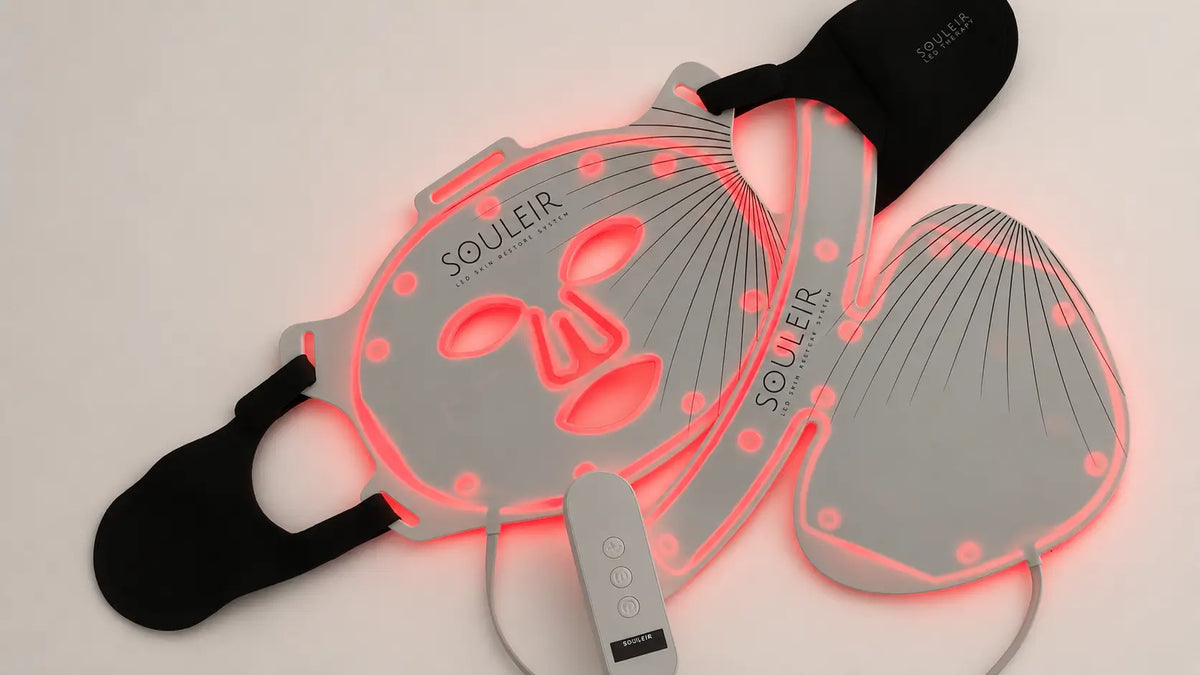
Functionally, it runs four wavelengths (red, near-infrared, blue, and amber) across face, neck, and chest in one 10-minute session, rather than requiring separate face-only and body attachments. At $799 (or $679 for subscribers), it's positioned to be used daily rather than rationed like a clinic appointment.
Putting it together
| Checklist item | Souleir Skin Restore Complete System |
|---|---|
| Red + near-infrared wavelengths | Yes - 4 clinically studied wavelengths, including red and near-infrared |
| Full coverage (face, neck, chest) | Yes - all three treated in one 10-minute session |
| Regulatory registration | TGA registered (Class IIa) and FDA cleared (510(k)) |
| Manufacturing & safety standards | ISO 13485, MDSAP, IEC 60601; independently EMF tested within ARPANSA/ICNIRP limits |
| Ongoing cost vs. clinic visits | One payment ($799, or $679 for subscribers) vs. $80–150 per clinic session |
If you're comparing specific brands side by side rather than shopping by checklist, our full 2026 comparison guide covers that in detail. And if you want the deeper science on why perimenopausal skin responds the way it does to red light, start here.
SHOP THE LED SKIN RESTORE SYSTEM $799 →
Frequently asked questions
What should I look for in an LED device for perimenopause skin?
Regulatory registration, clinically studied red and near-infrared wavelengths, sufficient light intensity, and coverage extending to the neck and chest.
Is a face-only LED mask enough during perimenopause?
Not really - the neck and chest often show hormonal skin changes just as early, and a face-only device leaves that untreated.
How much should an at-home LED device cost?
A well-specified device typically sits in the $700–800 range, which pays for itself against $80–150 clinic sessions within a handful of uses.
This article discusses cosmetic, skin-level considerations related to hormonal changes during perimenopause. The Souleir Skin Restore Complete System is TGA registered for its stated skin indications and is not a treatment for menopause, perimenopause, or any hormonal condition. Always consult your healthcare provider before starting any new treatment if you are pregnant, breastfeeding, or managing a medical condition.

Written by Therese Cassar

Leave a comment
This site is protected by hCaptcha and the hCaptcha Privacy Policy and Terms of Service apply.