

Article: Best LED Mask for Sensitive Skin in Australia (2026): Why Adjustable Intensity Matters More Than Wattage
Best LED Mask for Sensitive Skin in Australia (2026): Why Adjustable Intensity Matters More Than Wattage
Updated 2026 · 11 min read
Short answer
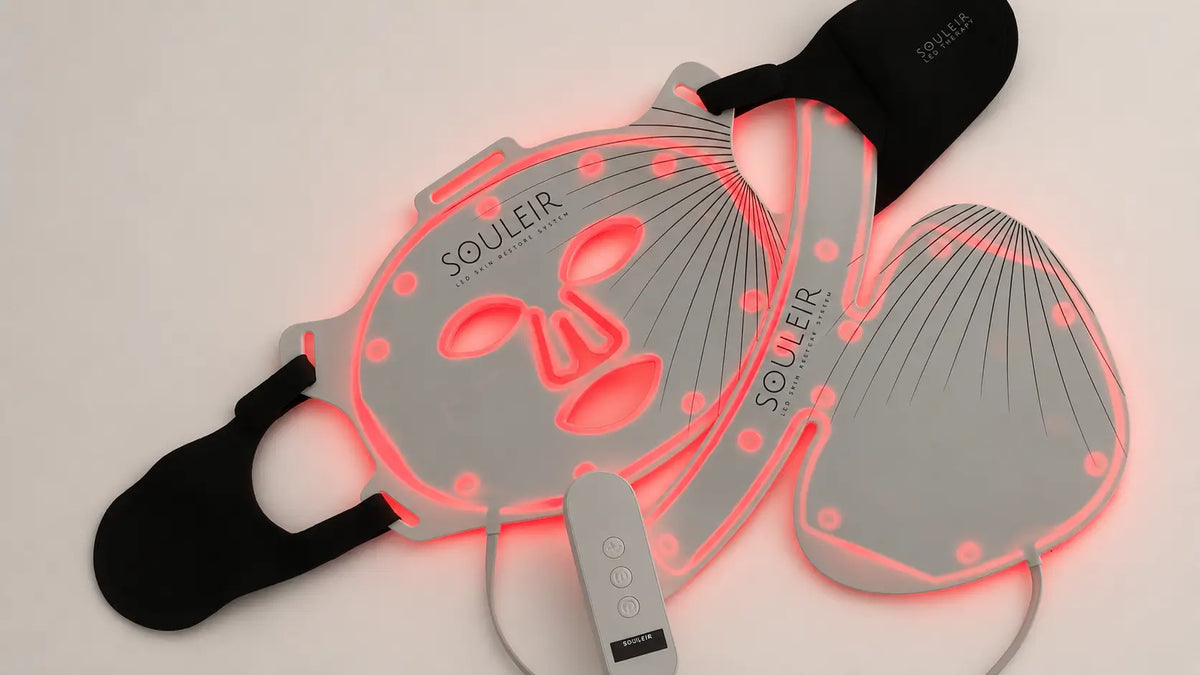
If you have sensitive, reactive, rosacea-prone or perimenopausal skin, the safest LED masks are the ones that let you control the intensity of every session, not just the light colour. Most masks on the Australian market run at one fixed output level. Souleir's Skin Restore System offers three intensity settings (60%, 80% and 100%), so you can start low and build tolerance over several weeks rather than exposing reactive skin to full-strength light from session one.
If you've ever tried an LED mask and come away with a face that felt tight, flushed or oddly hot for hours afterward, you're not imagining it, and you're not "doing it wrong." You're most likely reacting to a device that was never designed to be turned down.
This is a genuinely different problem to the one most LED mask reviews are solving. The existing "best LED mask Australia" roundups are written for skin that can tolerate a fixed, clinical-strength dose from the first session. That's a reasonable assumption for a lot of buyers. It's a bad assumption for a lot of others - and it's a particularly bad assumption for the growing number of women whose skin has become noticeably more reactive during perimenopause.
Why sensitive skin needs a different buying rule
Falling oestrogen during perimenopause thins the skin barrier and reduces its ability to hold onto moisture, which is a large part of why skin that was never "sensitive" before can suddenly start reacting to products, temperature and light exposure it previously tolerated without issue. Redness, warmth and a stinging or tight sensation after light-based treatments become far more common in this phase - not because something is wrong, but because the barrier is doing a different job than it used to.
A fixed-intensity LED mask doesn't know any of that. It delivers the same dose to a 25-year-old with resilient skin and a 48-year-old three years into perimenopause with a compromised barrier. If your skin falls into the second group, that's not a small design gap - it's the difference between a mask you can build into a weekly routine and one that sits in a drawer after two uneasy sessions.
What actually makes an LED mask safer for reactive skin
Wavelength gets most of the attention in LED marketing, and it matters - but wavelength alone doesn't determine how a session feels on reactive skin. Irradiance (how much power is actually hitting your skin) and whether that irradiance is adjustable matter just as much, arguably more, for anyone prone to redness or flare-ups.
Look for:
- Genuinely adjustable intensity levels (for example, 60% / 80% / 100% output), not just different colour "modes" - a lower setting should mean a genuinely lower dose, not the same dose in a different wavelength.
- A brand that publishes its wavelength and safety information clearly, rather than leaving you to infer it from marketing copy.
- Integrated eye protection, given how much time the device sits close to the eye area.
- A device that is TGA registered (ARTG listed) in Australia or carries equivalent international medical-device certification, rather than an uncertified import.
- A built-in timer and clear session-length guidance, so you're not relying on guesswork for how long is appropriate for your skin.
Dermatology guidance on LED and light-based treatments consistently recommends a cautious, gradual introduction for anyone with sensitive skin, photosensitivity, rosacea or a history of reacting to new treatments - starting with shorter or lower-intensity sessions and increasing only as the skin shows it can tolerate more.
A mask that can't be turned down simply can't follow that advice.

© 2026 Souleir. All rights reserved. This image is the exclusive property of Souleir and may not be copied, reproduced, distributed or used without prior written permission.
How the major LED masks compare on sensitive-skin criteria
Prices below are approximate and fluctuate with promotions - always confirm current pricing on the brand's own site before buying. Wavelength and clearance information reflects what each brand publishes.
| Device | Adjustable intensity | Wavelengths | Certification | Approx. price (AUD) |
|---|---|---|---|---|
| Souleir Skin Restore System | Yes - 3 levels (60%, 80%, 100%), designed to let skin build tolerance gradually | Blue 415nm, Amber 590nm, Red 660nm, Near-infrared 850nm (4 wavelengths, 744 LEDs) |
TGA registered (ARTG |
$799 |
| Omnilux Contour Face | No | Red 633nm, near-infrared 830nm | FDA cleared | ~$595–$679 |
| CurrentBody Skin LED Mask Series 2 | No | Red 633nm, Near-infrared 830nm, Deep near-infrared 1072nm | UKCA registered | $679.99 |
| CurrentBody Skin LED Mask Series 3 | No - app auto-calculates dose per LED; not strength adjustment within a wavelength | Blue 415nm, Green 532nm, Yellow 590nm, Red 633nm, Near-infrared 830nm, Deep near-infrared 1072nm (6 wavelengths, 750 LEDs) | Not published | $979.99 |
| Dr Dennis Gross DRx SpectraLite FaceWare Pro | No | Red 633nm, blue 415nm | FDA cleared | ~$650 |
| Shark CryoGlow | No | Red, blue and infrared | FDA cleared | ~$500–$550 |
Note: "adjustable intensity" here refers specifically to being able to lower the power output of a session (Souleir offers 60%, 80% and 100%), not simply switching between different light colours or preset programs. Most masks on the market offer the latter, not the former.
Why adjustable intensity is the actual differentiator, not a nice-to-have
Think of it the way you'd think about starting a new active ingredient in your skincare - you wouldn't introduce a strong retinoid at full strength, nightly, on skin that's never used one. You'd start low, a couple of nights a week, and build up as your skin adjusts. Light-based treatments deserve the same logic, but almost no mask on the market is built to let you apply it.
Souleir's Skin Restore System was designed around that gap.
Instead of one fixed output, it gives you three intensity settings -
- 60%,
- 80% and
- 100%
So, a first session can start well below what a fully tolerant user would run, and you move up a level over subsequent weeks as your skin shows it's ready, rather than guessing at session length as your only lever. This sits alongside the device's four wavelengths
- Blue 415nm,
- Amber 590nm,
- Red 660nm and
- Near-infrared 850nm,
so you're not just choosing a lower dose - you're choosing which wavelength combination suits your skin on a given day, at whichever intensity it can currently tolerate.
For perimenopausal skin, rosacea-prone skin, or skin that's simply become less predictable than it used to be, that's the difference between a device that becomes part of your week and one that gets used once and shelved.
This isn't about the mask being "gentler" in a vague sense. It's a specific, practical design decision:
the same device can meet you at the very cautious end of the spectrum in week one, and at full strength once your skin has proven it can handle it - without buying a second device or switching brands partway through.

A simple way to build tolerance
If your skin is reactive, perimenopausal, or you've had a rough experience with LED before, a cautious build-up looks something like this:
- Start at the 60% setting for your first two to three sessions, even if the instructions suggest most users can go higher.
- Leave at least 48 hours between early sessions so you can see how your skin responds before repeating.
- Move up one level at a time - 60% to 80%, then 80% to 100% - only once a session at the current level produces no lingering redness or warmth.
- If you're using other active skincare (retinoids, acids, prescription treatments), check with your dermatologist before layering LED on top, particularly while your skin is still adjusting.
This is general guidance, not a substitute for advice from your dermatologist. If you have a diagnosed skin condition, are pregnant or breastfeeding, or are photosensitive, speak with your healthcare provider before starting LED therapy of any kind.
Frequently asked questions
Is LED light therapy safe for sensitive or rosacea-prone skin?
Many people with sensitive or rosacea-prone skin tolerate LED well, particularly at a lower intensity and shorter session length while the skin adjusts. Anyone with a diagnosed skin condition or photosensitivity should check with a dermatologist first.
Why does my skin get more reactive to LED masks during perimenopause?
Declining oestrogen during perimenopause thins the skin barrier and reduces its moisture retention, which can make skin more reactive to treatments - including light-based ones - that it previously tolerated without issue.
What's the difference between adjustable intensity and different light modes?
Different modes typically change the colour or combination of light (for example, switching between red and blue). Adjustable intensity changes how much power is delivered within a mode.
Souleir's Skin Restore System separates the two:
- Choose from four wavelengths (blue 415nm, amber 590nm, red 660nm, near-infrared 850nm),
- Then choose an intensity of 60%, 80% or 100% for that session - the intensity setting is what actually matters for building tolerance on reactive skin.
How long before I can use an LED mask at full intensity?
This varies by individual, but a cautious approach for reactive skin is two to three sessions at 60%, moving to 80% and then 100% only once each level produces no lingering redness or warmth.
The real question isn't which mask has the highest spec sheet.
It's which one will still be safe to use on the days your skin decides to be difficult. If that's the skin you're working with, adjustable intensity isn't an added extra - it's the one feature that determines whether the mask earns a permanent place in your routine or ends up in a drawer. Souleir's Skin Restore System was built with that skin in mind.

Written by Therese Cassar

Leave a comment
This site is protected by hCaptcha and the hCaptcha Privacy Policy and Terms of Service apply.