

Article: What is Fluence? The Most Important LED Light Therapy Metric
What is Fluence? The Most Important LED Light Therapy Metric
LED light therapy in Australia · The details behind the dose
When you invest in an LED face mask, you are choosing a skincare routine you will repeat for weeks and months. Understanding its light dose helps you assess what that routine actually delivers.
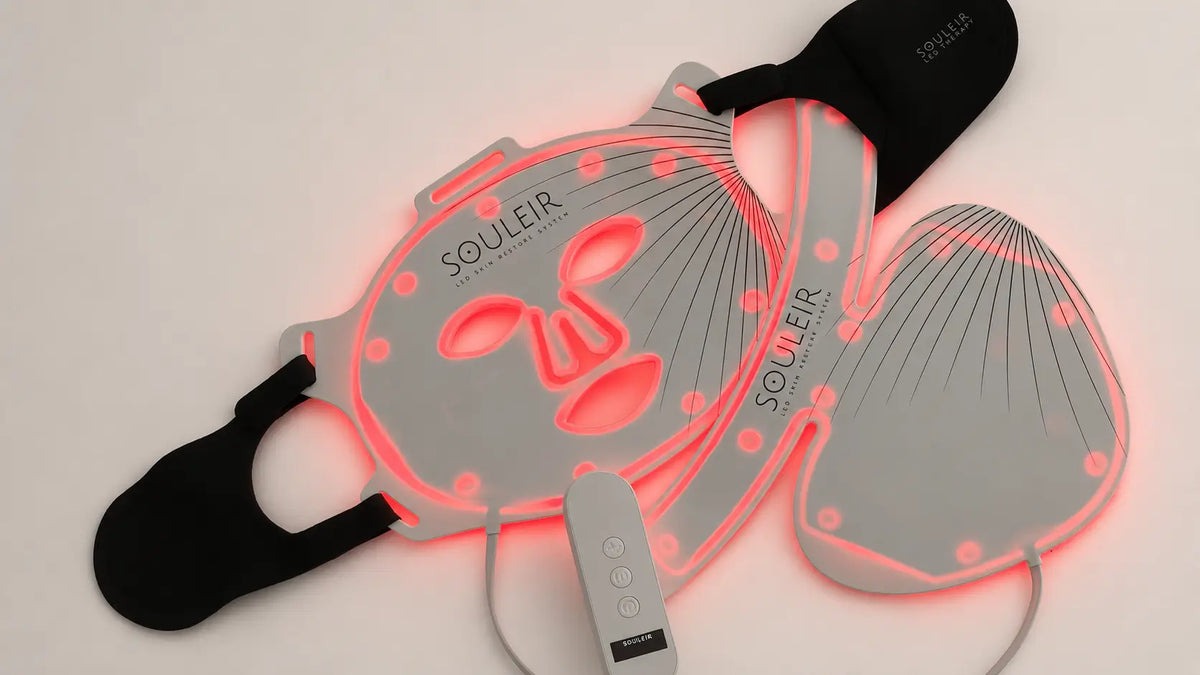
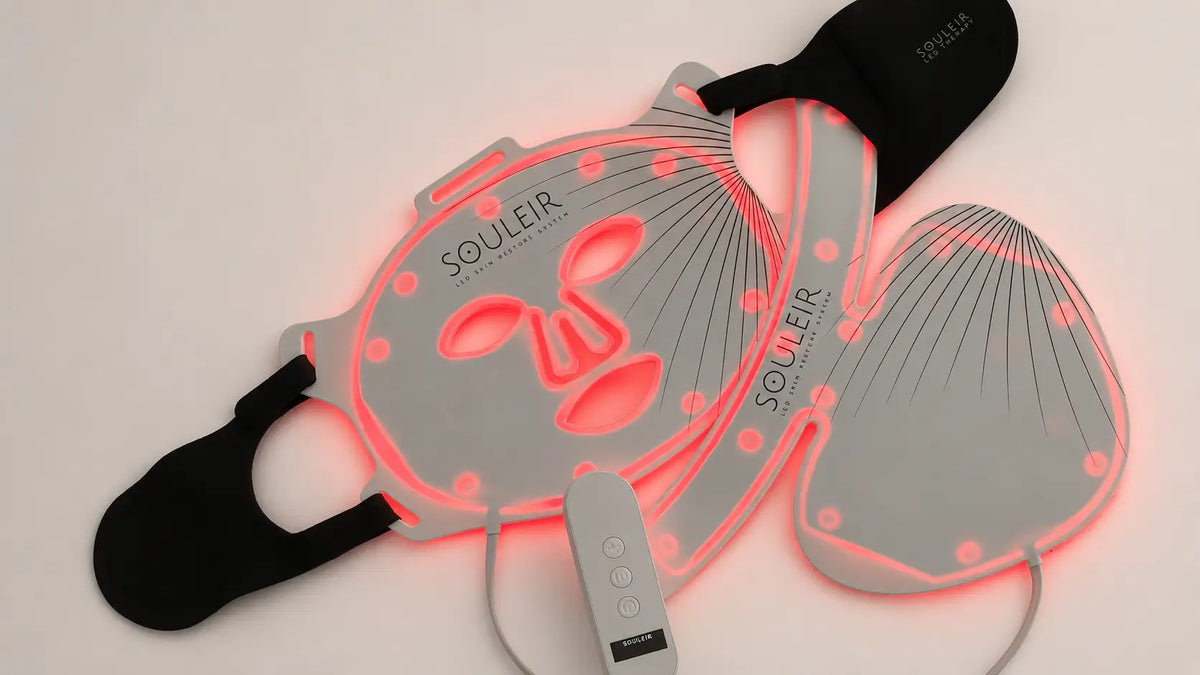
The Souleir LED Skin Restore System brings together four wavelengths, six programmes and 3 levels of adjustable intensity, with coverage for the face, neck and décolletage. Its irradiance of up to 41 mW/cm² corresponds to a calculated surface exposure of 24.6 J/cm² over 10 minute sessions..
So why does that number matter? It connects the strength of the light with the time spent using it. To judge efficacy, it belongs alongside the wavelength, treatment setting and clinical evidence.
By Souleir · Updated 18 October 2026 · Written for Australian buyers
The dose, explained simply
24.6 J/cm² describes the energy accumulated during a full 10-minute session at a sustained 41 mW/cm². The value makes Souleir’s stated light output understandable as a session exposure. Its importance comes from the combination of wavelength, output and time.
For you, that sits within a complete routine: two LED treatment pieces, one controller, four wavelengths and three intensity settings. You can include your face, neck and décolletage in the same timed session, or, use each LED panel separately - you choose.
What does 24.6 J/cm² mean in LED light therapy?
Fluence, also called radiant exposure, is the light energy delivered to each square centimetre during a session. It is expressed in joules per square centimetre, or J/cm². Irradiance is the delivery rate: light power per square centimetre, commonly expressed in mW/cm².
Think of irradiance as the rate of delivery and fluence as the session total. A dose specification needs both the output and the treatment time. Researchers also emphasise recording wavelength, treatment area, pulse parameters and schedule. [8]
Fluence (J/cm²) = irradiance (mW/cm²) × seconds ÷ 1,000
Calculation: 41 × 600 ÷ 1,000 = 24.6. This is derived from Souleir’s LED Skin Restore System output.
A total reading for a combined programme also needs to be interpreted correctly. If 41 mW/cm² is the combined output of red and near-infrared, 24.6 J/cm² is their combined exposure. It cannot be assigned to each wavelength individually without separate measurements.
Why does the light dose affect LED efficacy?
Photobiomodulation is the study of how appropriately delivered light can influence biological activity. The response depends on more than the number of LEDs: the light must reach the treatment area, be absorbed, and be delivered with suitable power and timing.
Why an adequate dose matters
Light arriving at the skin surface is only the beginning. Some light is reflected; some scatters or is absorbed as it travels through tissue. The energy reaching a particular layer therefore differs from the surface exposure.
That is why a surface measurement is valuable, but cannot tell us exactly how many joules reach collagen-producing fibroblasts. Skin pigmentation, wavelength, tissue properties and device placement all affect that relationship. [1]
For Souleir, the useful detail is that the stated output can be connected to a specified 10-minute session. This gives you a clearer basis for evaluating light delivery than LED count alone.
Understanding light delivery
When 41 mW/cm² is maintained continuously for 10 minutes.
Reflection, scattering and absorption influence where the energy travels.
The absorbed dose depends on wavelength, skin and delivery conditions. It cannot be calculated from the surface number alone.

© 2026 Souleir. All rights reserved. Reproduction without permission is prohibited.
Why a higher dose does not automatically improve results
Biological responses to light can be biphasic: increasing exposure may improve a response up to a point, after which the benefit can level off or diminish. That useful region changes with the tissue and treatment conditions.
In a laboratory study of human fibroblasts, van Breugel and Bär found that light power and exposure time affected cell proliferation; a higher tested power did not produce the stimulation seen with lower powers. This was a cell experiment using a laser, so its numerical settings cannot be transferred directly to a wearable LED mask. [2]
The practical lesson is to assess a complete treatment protocol. Doubling a session from 10 to 20 minutes would double the calculated exposure from 24.6 to 49.2 J/cm² at unchanged output. It would not establish twice the benefit.
A particular protocol may deliver too little light to produce its intended response.
Wavelength, irradiance, duration and schedule work together to influence the response.
Further exposure may add no benefit or reduce the response seen at a lower dose.

© 2026 Souleir. All rights reserved. Reproduction without permission is prohibited.
Why the 41 mW/cm² and 10-minute combination matters
At 41 mW/cm², each square centimetre receives 0.041 joules every second at the measurement position. Across 600 seconds, that builds to 24.6 joules. The duration is an essential part of how the stated dose is delivered.
For an at-home routine, this creates three useful points of control:
- A defined exposure: you can understand how the stated output relates to one session.
- A clear endpoint: the 10-minute automatic timer keeps the session length consistent.
- A choice of intensity: 60%, 80% and 100% settings let you select the output according to the supplied instructions.
These details make the routine easier to follow without complexity.
Where does 24.6 J/cm² sit alongside human skin research?
A controlled study of 136 volunteers by Wunsch and Matuschka offers context for both output and dose. Its four active groups received polychromatic light at total irradiances of approximately 10.3–54.8 mW/cm² and total session exposures of 15.5–51.4 J/cm², including approximately 9 J/cm² in the 611–650 nm band. After 30 treatments, complexion, roughness and ultrasound-assessed collagen density improved compared with controls. [3]
Souleir’s stated 41 mW/cm² and calculated 24.6 J/cm² fall numerically within those studied parameters. Our interpretation is that this provides useful human-study context for the scale of the output and exposure.
Why wavelength matters alongside fluence
A joule is a unit of energy, but equal numbers of joules at different wavelengths are not clinically interchangeable. A useful LED specification tells you which wavelengths are operating as well as how the exposure is calculated.
Souleir combines 415 nm blue, 590 nm amber/yellow, 660 nm red and 850 nm near-infrared across its six programmes. Red and near-infrared are relevant to research on the appearance of ageing skin; blue light has a different role in acne research. Amber is included in selected Souleir combinations, but its evidence and dosing should be assessed separately.
This also explains why the 24.6 J/cm² calculation should stay attached to the output conditions that support it. It is not automatically the blue-light dose, the amber-light dose, or the exposure in every programme.
Why consider the Souleir LED Skin Restore System?
For someone comparing at-home LED masks in Australia, Souleir offers a particularly practical combination: treatment coverage beyond the face, several wavelength combinations, and one controller for the whole system.
Two treatment pieces. One controller.
The complete system includes a face mask and a neck/décolletage panel. You can use them together or separately with one controller, giving you a straightforward way to include the neck and upper chest in your routine.
This matters if your skincare concerns extend beyond facial lines. You can choose coverage for the areas you want to include without assembling separate controllers and routines for each piece.
744 LED chips across the complete system
The face mask contains 488 LED chips within 122 four-chip beads. The neck/décolletage panel contains 256 LED chips within 64 four-chip beads. Together, that is 744 chips across 186 beads.
Each bead houses four wavelength chips. The selected programme determines which wavelengths operate, making several combinations available within the same treatment pieces. The 744 figure describes the chips installed across the system, with the active channels determined by your programme.
Three intensity settings and a timed session
The controller offers 60%, 80% and 100% intensity settings and a 10-minute automatic timer. You have a clear session endpoint and selectable output rather than needing to time treatment yourself.
A pulse function adds another delivery option. Its average dose depends on the pulse timing and output, so it should not be assumed to deliver the continuous-output fluence. Follow the supplied directions for selecting intensity and pulse settings.
All six Souleir LED programmes explained
The controller selects the wavelength combination for you. Four of the six programmes combine more than one wavelength; two use a single wavelength.
On mobile, swipe across the table to explore each programme.
| Programme | Wavelengths | How the setting differs |
|---|---|---|
| 1. Repairing | 660 nm red | A focused red-light option using the 660 nm channel. |
| 2. Rejuvenation | 590 nm amber/yellow + 660 nm red | Combines amber and red in one programmed session. |
| 3. Anti-Ageing | 660 nm red + 850 nm near-infrared | Pairs the red and near-infrared wavelengths discussed in the home-use photoageing research above. |
| 4. Morning Skincare | 590 nm + 660 nm + 850 nm | Three wavelengths together, without the blue channel. |
| 5. Anti-Acne | 415 nm blue | The dedicated blue-light setting. Use according to the device’s intended purpose and directions. |
| 6. Bedtime Skincare | 415 nm + 590 nm + 660 nm + 850 nm | A four-wavelength option combining blue, amber, red and near-infrared. |
Face, neck and décolletage
Bring your LED routine together.
Explore the Souleir LED Skin Restore System: two treatment pieces, four wavelengths, six programmes and three intensity settings, operated with one controller.
What supports trust in Souleir?
An Australian brand you can contact
Souleir is based in Queensland, Australia.
Souleir works with a specialist LED manufacturing partner with more than 20 years of experience in the LED industry. The system brings that specialist background together with direct Australian brand support, a controller that simplifies programme selection, and coverage for three areas of your skincare routine.
A public Australian regulatory reference: ARTG 510468
Souleir provides ARTG 510468 as its Australian Register of Therapeutic Goods reference. The public TGA record describes an active Class IIa home-use cosmetic phototherapy system. Its public summary gives an intended purpose covering wrinkles and mild to moderate acne. You can check the ARTG entry directly. [7]
The public record gives Australian shoppers a specific regulatory reference to check. Class IIa describes the device’s regulatory category; dose selection remains a separate question of treatment parameters and evidence.
Clear separation between specifications and research
In this article, the 24.6 J/cm² figure is a calculation from the stated irradiance and session time. The clinical studies are identified separately, with their wavelengths and limitations. That gives you a clearer basis for understanding the product and the evidence behind LED skincare.
How should you use a 10-minute LED routine?
Follow the instructions supplied with the system for preparation, fit, eye protection, programme choice and treatment frequency. The timer provides a consistent session length; the aim is to use the prescribed routine consistently.
Changing intensity, switching programmes or enabling pulse changes the delivery conditions. Avoid adding extra sessions simply to increase the joule total. Likewise, treating the face and neck together does not double the J/cm² received at one location: the pieces illuminate different areas.
Progress should be assessed over an appropriate treatment period. The studies above evaluated changes over several weeks with consistent use, with some outcomes assessed after months. Your result and timeframe will depend on the skin concern, protocol and individual response.
Always follow the directions for use. Check the contraindications and seek advice from a qualified healthcare professional if you are unsure about suitability. Stop use and seek advice if treatment causes an adverse reaction.
Frequently asked questions about LED mask fluence
What is a good fluence for an LED face mask?
A useful fluence is supported by evidence for the device’s wavelength, irradiance, duration, treatment schedule and intended skin concern. There is no single J/cm² figure that proves every LED mask effective.
What is the fluence of the Souleir LED Skin Restore System?
At a sustained irradiance of 41 mW/cm² for 10 minutes, the calculated surface exposure is 24.6 J/cm². This is based on Souleir’s stated maximum output and should be read with the relevant programme, intensity and pulse conditions.
Is a higher-irradiance LED mask always better?
No. Irradiance needs to be assessed with session time, wavelength, coverage and evidence. Increasing output or duration does not establish greater efficacy.
Does 24.6 J/cm² apply to every Souleir mode?
No. It is the calculation for a sustained 41 mW/cm² over 600 seconds. Different wavelengths, intensity settings and pulse operation need their own output measurements before a specific fluence can be assigned.
Is Souleir's LED devices TGA Registered?
Yes - Class IIa is a regulatory classification. (ARTG 510468).
Can I treat my face, neck and chest together?
The complete Souleir system includes a face mask and neck/décolletage panel. They can operate together or separately with one controller, following the supplied instructions.
The Souleir LED Skin Restore System
A considered addition to your skincare routine.
Choose your programme, select the intensity and include your face, neck and décolletage in a 10-minute session. See the complete system, current inclusions and warranty details on the product page.
Research and references
- Ash et al. (2017). Computational study of wavelength, beam width and light penetration in skin. Modelling research, not a measurement of Souleir’s internal tissue dose.
- van Breugel & Bär (1992). Power density, exposure time and human fibroblasts in vitro. Laboratory laser experiment; not a clinical trial of Souleir.
- Wunsch & Matuschka (2014). Controlled study of red and near-infrared light, skin appearance and collagen density. 136 volunteers; polychromatic light sources.
- Kim et al. (2020). Home-use 660/850 nm LED mask plus hyaluronic acid: a controlled photoageing study. 48 participants; four weeks; manufacturer-funded.
- Park et al. (2025). Home-use 630/850 nm mask for crow’s feet: a randomised, sham-controlled study. 60 adults; 16 weeks. DOI: 10.1097/MD.0000000000041596.
- Papageorgiou et al. (2000). Blue 415 nm and red 660 nm phototherapy for acne. Twelve-week treatment study.
- Therapeutic Goods Administration. ARTG entry 510468 and linked public summary. Class IIa home-use cosmetic phototherapy system. Record checked 18 October 2026.
- Jenkins & Carroll (2011). Reporting light-treatment dose and beam parameters. Guidance on documenting delivery conditions and measurements. DOI: 10.1089/pho.2011.9895.
Product and evidence note. Product specifications and manufacturing background are supplied by Souleir. The stated maximum irradiance has not been independently verified for this article. The 24.6 J/cm² calculation assumes that 41 mW/cm² is maintained continuously at the measurement position for 600 seconds. No per-wavelength, full-area or internal tissue dose is inferred. Results from other devices are not represented as clinical results for Souleir.

Written by Therese Cassar

Leave a comment
This site is protected by hCaptcha and the hCaptcha Privacy Policy and Terms of Service apply.