

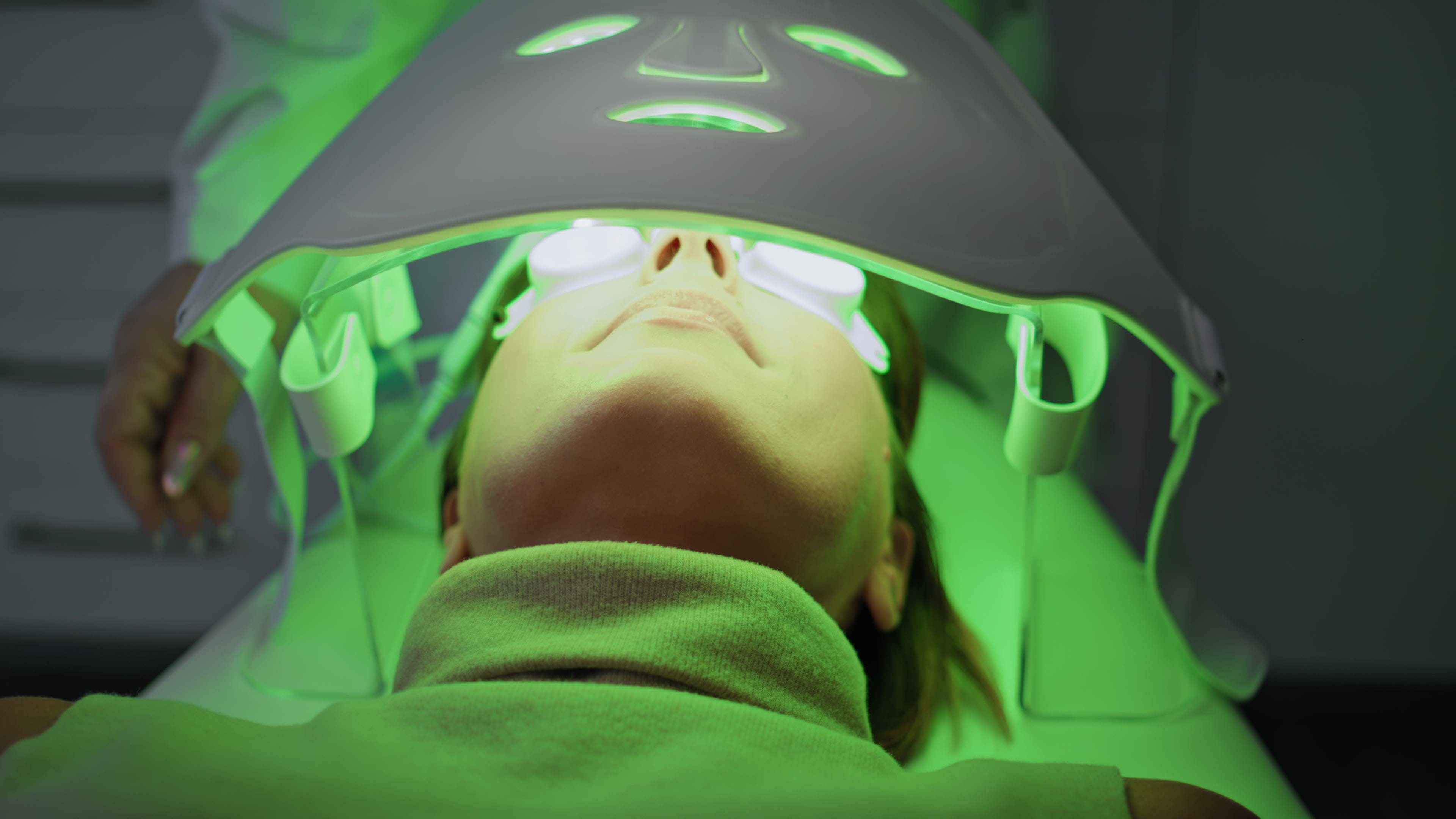
Does Red Light Therapy Actually Work? Here's What the Research Says
Yes, red light therapy works. Multiple peer-reviewed clinical studies confirm that red and near-infrared light stimulates collagen production, reduces inflammation, and accelerates skin cell repair at a cellular level.
Results are typically visible within 2 to 6 weeks of consistent use, with users reporting reduced fine lines, clearer skin, and improved skin tone.
It's a fair thing to be sceptical about. And if you're a woman in your 40s or 50s who has spent real money on skincare that didn't deliver, that scepticism is hard-earned.
So let's not sell you anything yet. Let's just look at what the research actually says.
What is red light therapy, exactly?
Red light therapy — also called photobiomodulation (PBM) or low-level light therapy (LLLT) — uses specific wavelengths of red and near-infrared light, typically between 630nm and 850nm, to penetrate the skin and trigger a biological response at the cellular level.
It is not a laser. It does not burn, cut, or ablate tissue. It does not generate heat you can feel. What it does is deliver light energy at a frequency your cells can absorb and use.
The mechanism is not mysterious. It was first documented in the 1960s by Hungarian physician Endre Mester, who found that low-level laser light accelerated wound healing and stimulated hair regrowth in mice. NASA later explored it in the 1990s for wound healing in astronauts. The research has been building steadily ever since.
What does the science actually say?
Here's what the peer-reviewed literature supports with reasonable confidence:
Collagen and elastin production.
A landmark 2014 study published in Photomedicine and Laser Surgery found that participants using red and near-infrared light treatment experienced significant improvements in fine lines, skin smoothness, and measurable collagen density. A 2007 study in the Journal of Cosmetic Dermatology confirmed LED therapy is a non-invasive, non-thermal method of skin rejuvenation with high patient satisfaction and visible results.
Cellular energy (ATP production).
The leading explanation for how red light therapy works involves the mitochondria — the part of each cell responsible for generating energy in the form of ATP. Research by Tiina Karu, a leading photobiology researcher, demonstrated that specific red and near-infrared wavelengths are absorbed by cytochrome c oxidase, a key enzyme in the mitochondrial respiratory chain.
The result:
Cells produce more energy, function more efficiently, and repair themselves faster.
Inflammation reduction.
Multiple studies show red light therapy reduces markers of chronic inflammation — not just at the skin surface, but systemically. This has significant implications for conditions like rosacea, acne, and the generalised skin sensitivity many women experience during perimenopause, when falling oestrogen levels create a pro-inflammatory environment in the skin.
Wound healing and tissue repair.
Red light therapy has been used in clinical and surgical settings for decades for its demonstrated ability to accelerate healing, reduce scarring, and support tissue regeneration.
So is red light therapy a hoax?
No. But there is a legitimate reason the scepticism exists.
The problem isn't the technology - it's the industry around it.
The past decade has seen an explosion of cheap, underpowered devices marketed with clinical-sounding claims. Many deliver insufficient irradiance (the measure of light energy hitting the skin) to actually trigger a cellular response. Others use the wrong wavelengths. Unlike Souleir's devices, some are not TGA-approved for therapeutic use in Australia.
When these devices don't produce results, people reasonably conclude the whole category is nonsense. They're not wrong about that specific product. They're wrong to dismiss the science.
The research on photobiomodulation is not fringe.
It has been published across more than 6,000 peer-reviewed papers. It underpins clinical applications in wound care, physiotherapy, dentistry, and dermatology. The Therapeutic Goods Administration (TGA) - Australia's medical device regulator - has approved specific LED devices for therapeutic use, which requires meeting rigorous safety and efficacy standards.
The distinction matters:
Poor-quality red light therapy doesn't work. Properly specified, TGA-approved red light therapy has meaningful evidence behind it.
What red light therapy cannot do
Transparency matters here. Red light therapy is not:
-
A replacement for sunscreen, a consistent skincare routine, or professional dermatological care
-
A treatment for skin cancer or serious medical conditions
-
An overnight fix — results are cumulative and typically become visible after 2–12 weeks of consistent use
It is also not suitable for everyone without consideration. Women who are pregnant, have a history of photosensitivity conditions, take photosensitising medications, should consult a healthcare professional before starting any light therapy protocol.
What Australian women are actually experiencing
The clinical data is one thing. What does consistent use look like in practice?
Souleir users — particularly women in their 40s and 50s — most commonly report the following after 2–12 weeks of regular use:
-
Visibly softer fine lines, especially around the eyes and mouth
-
More even skin tone and reduced redness
-
Improved skin texture — less rough, more luminous
-
Reduced frequency and intensity of rosacea flares
-
Firmer-feeling skin, particularly along the jawline and neck
These align with what the research would predict. Collagen density improves gradually. Inflammation decreases with consistency. Cellular repair is a slow, compounding process — not a dramatic overnight shift.
The bottom line
Red light therapy works — when the device meets clinical specifications, when it is used consistently, and when expectations are realistic.
It is one of the few at-home skincare technologies with genuine peer-reviewed evidence behind it, regulatory approval in Australia, and a mechanism of action that holds up to scrutiny.
For women navigating the skin changes that come with perimenopause and beyond — where declining oestrogen accelerates collagen loss, increases inflammation, and compromises the skin's natural repair capacity — it addresses several of those underlying drivers simultaneously.
It will not replace everything in your routine. But for consistent, non-invasive skin support you can do in ten minutes at home, very little else has this level of evidence behind it.
About the Souleir Youth Restore LED Therapy Mask
The Souleir Skin Restore LED Therapy Mask is
- TGA-approved,
- FDA-certified, and
- ISO 13485 certified for medical device manufacturing standards.
It delivers four clinically relevant wavelengths
- Red (660nm),
- Near-infrared (850nm),
- Blue (415nm), and
- Yellow (590 nm
6 combination modes — at an optimal irradiance of 30–35 mW/cm² across 488 LEDs in the face mask, and an additional 256 LEDs in the neck and décolletage panel. Avoids excessive power to prevent photochemical stress, ensuring maximum effectiveness.
It is designed for daily use at home, takes 10–20 minutes per session, and is built from flexible food-grade silicone to ensure consistent skin contact across the face, neck, and décolletage.
Shop the Souleir LED Skin Restore LED Therapy Mask →
This article is for informational purposes only and does not constitute medical advice. If you have a diagnosed skin condition or health concern, please consult a qualified healthcare professional before beginning any new treatment.

Written by Therese Cassar

Leave a comment
This site is protected by hCaptcha and the hCaptcha Privacy Policy and Terms of Service apply.